PLEASE CLICK THE LINK FOR REVIEW ON ANCIENT GREECE
ANCIENT GREEK CULTURE
BELOW IS ALSO THE LINK TO LEARN MORE ABOUT TYRIAN PURPLE
TYRIAN PURPLE
YOUR ANCIENT GREECE FASHION PLATE FOR YOUR FASHION HISTORY BOOK IS DUE ON THURSDAY.
PLEASE CONSIDER THE FOLLOWING IN YOUR EXPLANATION OF THE CLOTHING.
- USE THE TEXT TO FIND "ACTION WORDS" TO DESCRIBE THE CLOTHING
- DESCRIBE WHY THIS TYPE OF CLOTHING/JEWELRY/MAKEUP WAS WORN
- DISCUSS THE CULTURE OR IMPORTANT PEOPLE OF THE ERA
COMMENT IN THE SECTION BELOW WITH QUESTIONS
Wednesday, February 10, 2016

Thursday, February 4, 2016
ANCIENT GREECE CLOTHING DESCRIPTION
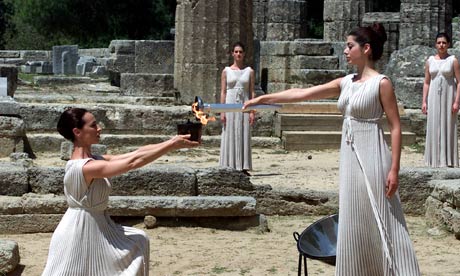
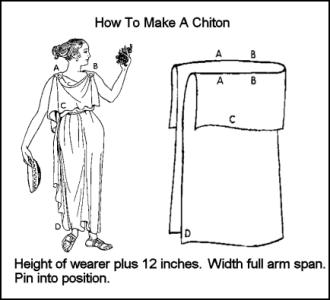
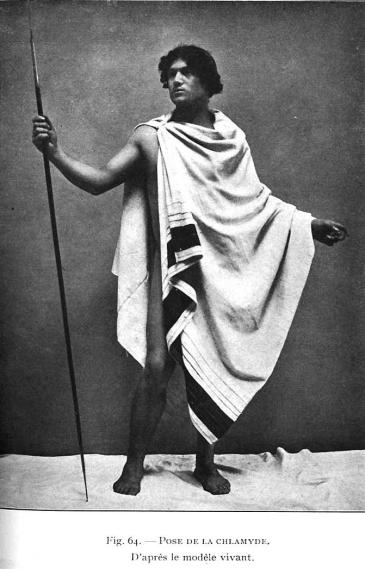
PLEASE WATCH VIDEO AND NOTE THE THREE MAIN TYPES OF GREEK CLOTHING AND HOW THE CLOTHING WAS WORN
ALSO PLEASE NOTE THESE CLOTHING DESCRIPTIONS IN YOUR MOVIE RESPONSE
ANY QUESTIONS PLEASE RESPOND BELOW IN THE COMMENTS SECTION
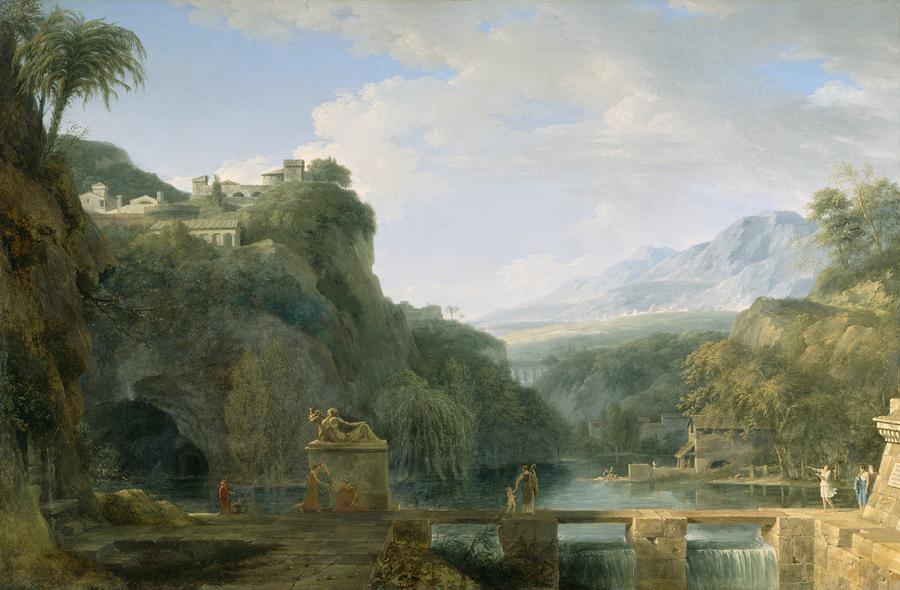
ANCIENT GREECE



WATCH: Alexander
VALUES:
Ancient Greek civilization has contributed to many parts of today's society. The teachings and doings of ancient Greeks have remained important lessons that many societies still base their own laws and ethics on. The ancient Greeks implemented their values of loyalty, glory, intelligence and hospitality into everyday life. While these values may seem simple, they effectively shaped an entire civilization into a culture that is one of the most referenced in history.
Read more : http://www.ehow.com/info_8447171_values-ancient-greeks-value-highly.html
Read more : http://www.ehow.com/info_8447171_values-ancient-greeks-value-highly.html
Ancient Greek civilization has contributed to many parts of today's society. The teachings and doings of ancient Greeks have remained important lessons that many societies still base their own laws and ethics on. The ancient Greeks implemented their values of loyalty, glory, intelligence and hospitality into everyday life. While these values may seem simple, they effectively shaped an entire civilization into a culture that is one of the most referenced in history.
Ancient Greek civilization has contributed to many parts of today's society. The teachings and doings of ancient Greeks have remained important lessons that many societies still base their own laws and ethics on. The ancient Greeks implemented their values of loyalty, glory, intelligence and hospitality into everyday life. While these values may seem simple, they effectively shaped an entire civilization into a culture that is one of the most referenced in history.
Read more : http://www.ehow.com/info_8447171_values-ancient-greeks-value-highly.html
Read more : http://www.ehow.com/info_8447171_values-ancient-greeks-value-highly.html
Ancient Greek civilization has contributed to many parts of today's society. The teachings and doings of ancient Greeks have remained important lessons that many societies still base their own laws and ethics on. The ancient Greeks implemented their values of loyalty, glory, intelligence and hospitality into everyday life. While these values may seem simple, they effectively shaped an entire civilization into a culture that is one of the most referenced in history.
Read more : http://www.ehow.com/info_8447171_values-ancient-greeks-value-highly.html
Read more : http://www.ehow.com/info_8447171_values-ancient-greeks-value-highly.html
Ancient Greek civilization has contributed to many parts of today's society. The teachings and doings of ancient Greeks have remained important lessons that many societies still base their own laws and ethics on. The ancient Greeks implemented their values of loyalty, glory, intelligence and hospitality into everyday life. While these values may seem simple, they effectively shaped an entire civilization into a culture that is one of the most referenced in history.
Read more : http://www.ehow.com/info_8447171_values-ancient-greeks-value-highly.html
Read more : http://www.ehow.com/info_8447171_values-ancient-greeks-value-highly.html
he ancient Greeks implemented their values of loyalty, glory, intelligence and hospitality into everyday life. While these values may seem simple, they effectively shaped an entire civilization into a culture that is one of the most referenced in history.
Read more : http://www.ehow.com/info_8447171_values-ancient-greeks-value-highly.html
Read more : http://www.ehow.com/info_8447171_values-ancient-greeks-value-highly.html
he ancient Greeks implemented their values of loyalty, glory, intelligence and hospitality into everyday life. While these values may seem simple, they effectively shaped an entire civilization into a culture that is one of the most referenced in history.
Read more : http://www.ehow.com/info_8447171_values-ancient-greeks-value-highly.html
Read more : http://www.ehow.com/info_8447171_values-ancient-greeks-value-highly.html
WOMEN:
Greek women had virtually no political rights of any kind and were controlled by men at nearly every stage of their lives. The most important duties for a city-dwelling woman were to bear children--preferably male--and to run the household. Duties of a rural woman included some of the agricultural work: the harvesting of olives and fruit was their responsibility, as may have been the gathering of vegetables.Since men spent most of their time away from their houses, Greek home life was dominated by women. The wife was in charge of raising the children, spinning, weaving and sewing the family´s clothes. She supervised the daily running of the household. In a totally slave-based economy, plentiful numbers of female slaves were available to cook, clean, and carry water from the fountain. Only in the poorest homes was the wife expected to carry out all these duties by herself. A male slave´s responsibilities were for the most part limited to being door-keeper and tutor to the male children.
Custom dictated that a Greek woman limit her time outside the house to visiting with her nearest female neighbors. Exceptions to this rigid social convention were weddings, funerals and state religious festivals in which women were expected to play prominent public roles.
RESOURCES:
Greek clothing was made out of three types of materials. The first mostly used was wool which was woven from very coarse to very soft. They used linen grades from fine to very soft. Drapery in Greek culture did not fold crisply like Egyptian folds fell and the linen was not as stiff as the linen used in Egypt.
Ancient Greek jewelry:


Ancient Greek Hair:


DATES: 3000 - 100 BCE |   | ||||||||||||||||||||||||||||
Men wore their hair long at the beginning of Greek culture but it soon became fashionable to have shorter hair with little facial hair. Older men would wear mustaches with a shortly-trimmed beard and if a man had a mustache and no beard they were not Greek. In the archaic period women wore their hair hanging in snaky curls held by a fillet but as time passed women would wear their hair up and confined in bag, kerchiefs or nets.
Colors of this period were bright-hued like yellow, indigo, green, violet, dark red, dark purple and colors that were from the earth. Motifs ranged from geometric like the dentil and arrangements of circles and squares to vegetable forms like the laurel, ivy and waterleaf.
Notable Greek Clothing Elements


.jpg)


 |
 |
Tuesday, February 2, 2016
RESEARCH FOR FASHION HISTORY BOOK
YOUR FIRST FASHION PLATE FOR YOUR FASHION HISTORY BOOK IS DUE ON THURSDAY.
PLEASE CONSIDER THE FOLLOWING IN YOUR EXPLANATION OF THE CLOTHING.
- USE THE TEXT TO FIND "ACTION WORDS" TO DESCRIBE THE CLOTHING.
http://www.cwu.edu/~robinsos/

PLEASE CONSIDER THE FOLLOWING IN YOUR EXPLANATION OF THE CLOTHING.
- USE THE TEXT TO FIND "ACTION WORDS" TO DESCRIBE THE CLOTHING.
- FOR EXAMPLE - SCHENTI, SHENDOH, PSCHENT
- FOR EXAMPLE - KOHL WAS WORN TO PROTECT THE EYES
- FOR EXAMPLE - SLAVES AND PHAROAH, ETC.
- KING MENES
- NEFERTITI
- IMHOTEP
http://www.cwu.edu/~robinsos/
Wednesday, January 27, 2016
ANCIENT EGYPT - EARLY COSTUMES
Ancient Egypt
VALUES:
Tradition and Symbolism
•This is a society that was unchanging for hundreds of years - a strict hierarchy where everyone kept to their place, and tradition was key.
•The repeating cycles of flood, planting and harvest, and the endless turn of the sun and moon created a very stable, traditional and rule bound culture.
•Family and children were very important
•Women were respected, but subservient to fathers and husbands
•Motherhood was the greatest virtue
•Children apprenticed to learn a trade
•Children were expected to care for their parents
Society:
Egyptian society was hierarchical, traditional, structured and authoritarian- people were born into a place in society, and there was little mobility. The King or Pharoah was seen as a god. Soldiers, nobility and craftspeople followed their family path. Tradition was very important. Slaves were born to slavery or captured in war.
Women:
Women were very respected but had few rights as individuals. Motherhood was revered and aspired to."Never forget your mother...remember you burdened her womb for a long time and when her time had passed, she gave birth to you. For three long years she carried you on her shoulders and offered her breast to your mouth. She reared you and was not offended by your dirty ways."
Resources:
Primarily linen, also some other vegetable fibers and limited use of leather and wool.What they wore:
Silhouette:
White, simple and close to the body for both men and women. Accentuated with lavish jewelry, wigs and make-upMen wore:
A loincloth or skirt made of linen, accentuating the hips. Sometimes an overpiece that brought attention to the groin area. Men were clean shaven, but wore make-up, jewelry and sometimes wigs.Women wore:
A long tight sheath dress fastened beneath the breasts. Jewelry, make-up and wigs.Jewelry:
Collars and pectorals of gold and gemstones. Multiple bracelets and rings on fingers and in hair. Symbolism was important: eye of horus, scarabs, flowers etc.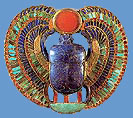

Grooming:
Daily bathing and oiling of skin, exfoliating. Many beauty treatments. Make-up for both sexes: skin powders and kohl or malachite powder around the eyes. Lip gloss and rouge. Nails reddened with henna.
Footwear:
Sandals, mostly of the thong type
Ancient Egypt - 1500-1300 B.C.

Egyptian Costume
The Egyptian clothed figure exhibits two typical figures. The first is an extreme scantiness of simple, undraped garments that reveal the figure even when the garment covers the whole body. Egyptians concentrated on draping material across the body and center the folds on the front of the body. When they did this it would show the outline of the back.
Egyptian garments are always simple in their construction and cut. The major changes that the garments went through as time passed on and the Empire took control was that they were more ample in their material. This gave the them more cloth to drape gracefully across the body. The clothes of men and women were fundamentally alike.
Men wore little clothes, however clothing in the Egyptian period was influenced by two things: the first the position of the wearer and then the second its adaptation to the convenience of the wearer. Men wore their hair in a bob, thick and abundant in a long style or shaved heads with wigs. They wore headdresses and fillets that wrapped around their curly locks of hair. Women wore fillets and headdresses too. Their tunics were like the men's but belted higher and the clothing was short-waisted with the material confined to the breast and radiated from them.
Schenti - a loincloth; a rectangular piece tied in front in a knot and made of linen.   | |||
Shendoh—Loin cloth for the Pharaoh. | |||
Kalisiris - Gown like wrap often from under the bust some-times transparent 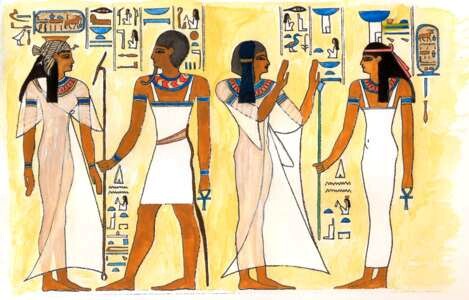    | |||
Pectoral—A trapezoidal-shaped piece of decorative metal and gemstones worn about the neck by nobility.  | |||
  | |||
Postiche—False beard, made of leather, felt, or metal. Reserved for the Pharaoh. | |||
Fillet—A piece of metal, leather or ribbon that wrapped around the head to hold the hair in place. It was worn as a headpiece by men and women.  | |||
Girdle—A piece of leather, ribbon or fabric that would wrap around the body at the waist or the hips to smooth out the clothing of the wearer and to create folds that were popular to wear.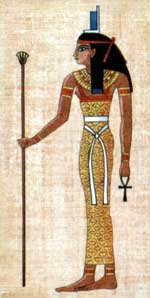  | |||
Kohl—A black cosmetic substance, comprised of ground Galena (a black mineral) sulphur and animal fat ,used in Egyptian makeup for the eyes and eyebrows. It was know to have alleviated eye inflammations and protected the eyes from the sun  | |||
Henna—Hand and nail dye, from a shrub or tree whose leaves gave a red-orange dye. | |||
Pschent—The red crown of lower Egypt, worn on the white crown when the two kingdoms of Egypt were united. Homework - Using sources. BEST: Primary A primary source is a document or physical object which was written or created during the time under study  |

NOT EVEN A LITTLE OKAY:
The kind of b.s. that you get from doing a Google search for "Egyptian." These will often include Halloween costumes or video game characters. Do not use an image if you aren't sure that it's accurate.
NOT OKAY

NOT OKAY
 |
| NOT OKAY |
 |
| NOT OKAY |
HOMEWORK: Create a mood board/collage on the topic of Ancient Egyptian fashion. The piece should be 7 x 11. It should include images that are MOSTLY from primary sources. Consider the whole piece. It is a piece of art, and should be clean and attractive as well as informative. MAKE IT WORK!
Reading:
Chapter One - pages 13 - 29.
THERE WILL BE A QUIZ ON TUESDAY
Subscribe to:
Posts (Atom)